Myopia Control

What Is Myopia Control?
Myopia control is a proactive approach to slowing the progression of childhood nearsightedness and helping protect your child’s long-term eye health. Myopia, or nearsightedness, occurs when the eye grows too long from front to back. As the eye elongates, distant objects become blurry and stronger glasses are needed. Without treatment, many children’s myopia continues to progress year after year throughout childhood and adolescence.
Early detection is important because higher levels of myopia increase the risk of serious eye conditions later in life. Fortunately, today’s myopia control treatments can help slow eye growth and reduce the rate at which your child’s prescription changes.
Signs Your Child May Be Developing Myopia
- Squinting to see distant objects
- Sitting close to screens
- Difficulty seeing the classroom board
- Complaints of blurry distance vision
- Parents with significant nearsightedness

Why Myopia Matters
Many parents assume stronger glasses are simply an inconvenience. In reality, increased myopia not only means greater dependence on glasses or contact lenses but also is associated with increased lifetime risk of serious eye disease. As the eye becomes longer, there is a dramatically increased risk of the following complications:
- Retinal Detachment
- Glaucoma
- Cataracts
- Myopic Macular Degeneration
Our goal is not simply to reduce prescription changes. Our goal of myopia control is to reduce excessive eye growth and help protect long-term eye health.
Is My Child at Risk for Progressive Myopia?
Not all children experience myopia progression at the same rate. Several factors help us predict which children are most likely to develop worsening nearsightedness over time.
- Age – Children who become nearsighted at a younger age often experience more years of eye growth and are more likely to develop higher levels of myopia.
- Current Prescription – Children whose prescriptions continue to increase year after year may be at risk for ongoing progression.
- Axial Length – One of the most important measurements in modern myopia management is axial length—the physical length of the eye. Just as pediatricians use growth charts to track height and weight, we compare your child’s eye growth to age-based norms.
- Family History – Children with one or both parents who are nearsighted have a higher risk of developing progressive myopia.
- Environmental Factors – Research suggests that excessive near work, prolonged screen time, and limited outdoor activity may contribute to myopia development and progression.
Children should receive their first comprehensive eye exam by age 5–6, even if they are not experiencing vision problems.
Why Early Eye Exams Matter
Early detection provides the greatest opportunity to monitor eye growth and intervene with myopia control before significant progression occurs. Many children do not realize their vision is blurry because they assume everyone sees the way they do.
The American Optometric Association recommends comprehensive eye examinations for children before they start school. At O’Fallon Family Eye Care, we generally recommend a child’s first comprehensive eye exam around age 5 to 6, or sooner if concerns exist.
The earlier we identify a child at risk, the more opportunities we have to slow progression.
Myopia Measured, Not Guessed
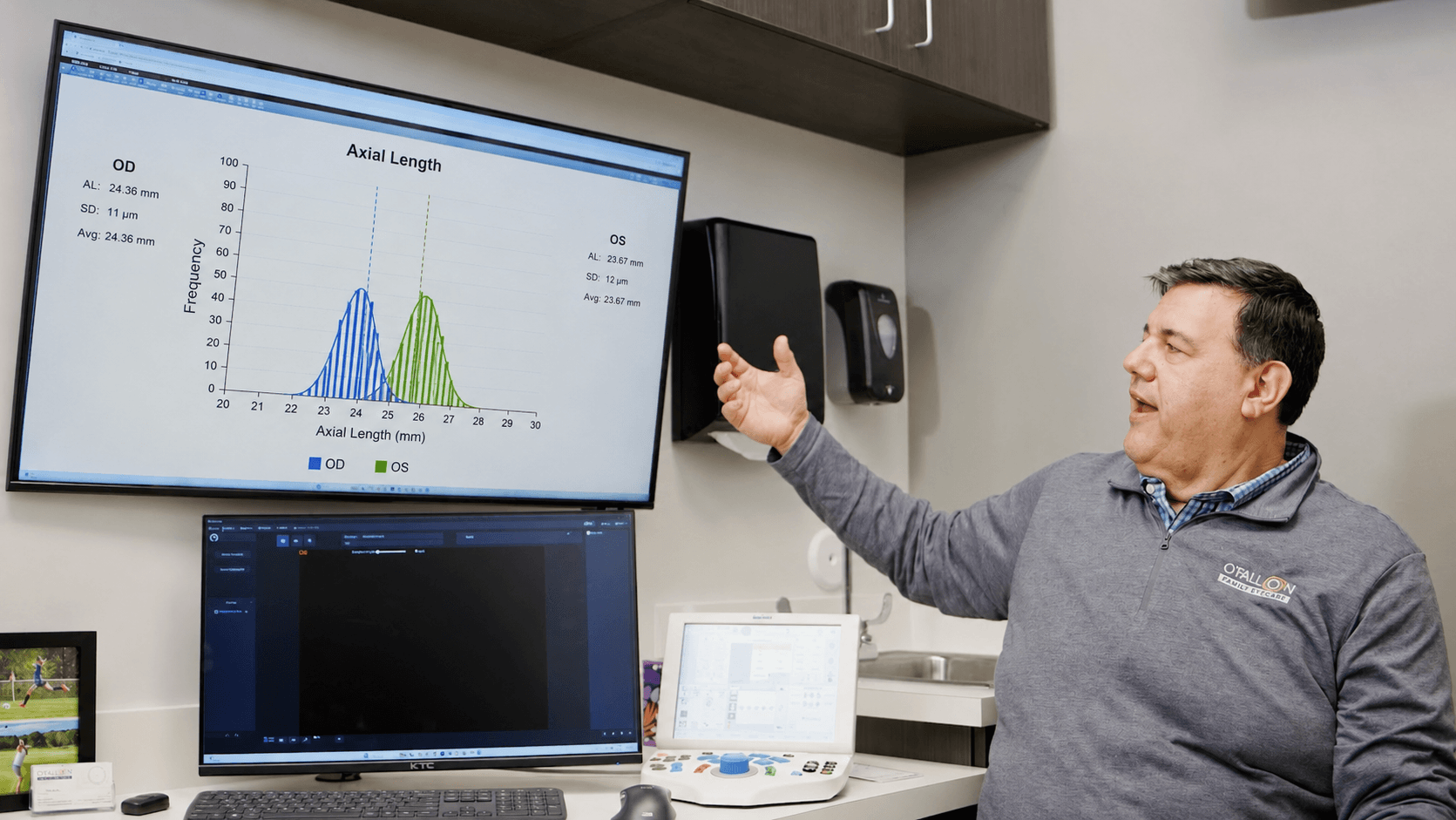
Myopia control starts with measuring it accurately. The glasses prescription is a good start, but axial length measurements provide a more accurate way to monitor myopia progression and assess the risk of future eye diseases associated with high myopia.
Using advanced axial length technology, we can track how your child’s eyes are growing and detect changes long before they become obvious in a glasses prescription.
Most eye exams measure how blurry vision is today. We also measure how the eye is growing. Using advanced biometry with the Topcon Myah, we measure axial length—the physical length of your child’s eye—and compare it to age-based growth charts.
Our myopia management program allows us to: detect abnormal eye growth early, monitor progression more precisely, evaluate treatment effectiveness, and make better treatment decisions over time
Think of axial length measurements like a growth chart. Just as your pediatrician tracks height and weight, we track eye growth. A prescription tells us how blurry vision is today. Axial length helps us understand where your child’s vision may be heading in the future.
Our Approach to Myopia Management
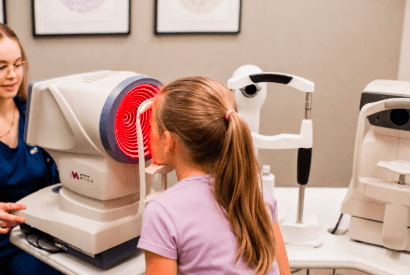
Step 1 – Evaluate – Start with a comprehensive view of your child’s myopia status, assess risk of progression and future eye health, and answer your questions.
Step 2 – Customize – The doctor will guide you through the best treatment options for your child’s age, level of myopia, and lifestyle.
Step 3 – Monitor – Myopia control is not a one-time treatment. Regular follow-up visits allow us to monitor prescription changes, track axial length growth, and ensure treatment remains effective as your child grows.
Why Families Choose O’Fallon Family Eyecare
Personal Experience – Our doctors don’t just look at numbers on a chart—they treat your child with a deep, personal understanding of what it’s like to walk in their shoes, bringing unmatched passion and empathy to your child’s care.
High Tech Care – We measure eye growth directly using advanced axial length technology, allowing us to track myopia progression with precision rather than relying solely on prescription changes.
Proven Treatments – Instead of pushing a one-size-fits-all product, we offer a versatile Myopia Management Program featuring multiple evidence-based paths.
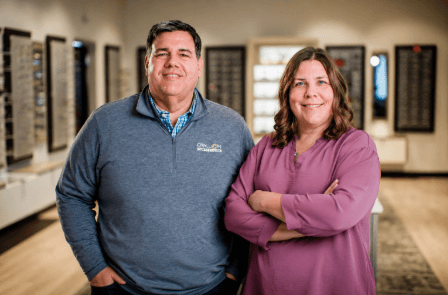
Drs. Joe and Laura Hegyi
Whether your child is best suited for soft lenses like MiSight®, custom overnight lenses via Ortho-K, advanced Stellest lenses or Low-Dose Atropine Eye Drops, we tailor the treatment plan to fit myopia control seamlessly into your family’s actual lifestyle.
Our Myopia Management Options
No single treatment is best for every child. We customize recommendations based on age, prescription, eye growth patterns, lifestyle, and family goals. Our doctors will help you discover which is the best option for your child.

Orthokeratology (Ortho-K)
Ortho-K uses customized lenses worn overnight to temporarily reshape the cornea, providing clear vision during the day without glasses or contacts. This reshaping also changes how light focuses in the eye, helping slow myopia progression.

MiSight Contacts
Specially designed soft lenses gently change how light focuses in the eye, helping slow myopia progression while giving children clear daytime vision. These are a good fit for active children or teens who prefer not to wear glasses.

Stellest Lenses
Newer spectacle lens designs use tiny lens zones that help slow myopia progression. Children wear them like normal glasses, making them an easy option for families who prefer not to use contact lenses.

Atropine
Prescription eye drops used nightly to help slow eye growth. Atropine is commonly recommended for children with progressive myopia and can be a good option for families who are not ready for contact lenses.
Frequently Asked Questions
What age should myopia management begin?
The best time to begin myopia management is as soon as a child is identified as being at risk for progressive myopia.
For many children, this is around ages 6–12, but there is no single “correct” age. We consider several factors when making recommendations, including your child’s age, prescription, rate of progression, axial length measurements, family history, and lifestyle.
In general, earlier intervention provides the greatest opportunity to slow eye growth and reduce the risk of developing high myopia later in life. That’s why we recommend comprehensive eye exams by age 5–6 and regular monitoring as children grow.
Is my child too young for contact lenses?
Age is usually not the most important factor when determining whether a child is ready for contact lenses. Maturity, responsibility, and family support are often much better indicators of success.
Many children successfully wear contact lenses for myopia management starting between ages 8 and 12, and some younger children may also be good candidates. In fact, studies have shown that children can often handle contact lens wear just as safely and successfully as teenagers when proper training and supervision are provided.
During your child’s evaluation, we will discuss their lifestyle, activities, hygiene habits, and treatment goals to determine whether contact lenses are an appropriate option. If contact lenses are not the best fit, effective alternatives such as Stellest® spectacle lenses or low-dose atropine may also be considered.
Are these treatments covered by insurance?
Many vision insurance plans provide benefits that can help offset a portion of the cost of myopia management. In many cases, vision plans may contribute toward glasses, contact lenses, or other treatment materials, helping reduce out-of-pocket expenses.
Professional services associated with myopia management—such as specialized testing, axial length measurements, treatment planning, and ongoing monitoring—are often not covered by vision insurance and may require separate fees.
Because coverage varies widely between plans, our team will review your benefits and explain any available coverage before treatment begins. We are committed to helping families understand their options and make informed decisions about their child’s care.
How much can progression be slowed?
While no treatment can guarantee that myopia will stop completely, research has shown that modern myopia management treatments can significantly slow the progression of nearsightedness in many children.
The amount of benefit varies from child to child and depends on factors such as age, prescription, eye growth patterns, treatment type, and how consistently treatment is followed. Some children experience modest slowing, while others experience significantly less progression than would be expected without treatment.
Our goal is not only to reduce prescription changes, but also to slow excessive eye growth. By monitoring both prescription and axial length over time, we can evaluate how well treatment is working and make adjustments when needed.
Can treatment stop myopia completely?
Myopia management treatments are designed to slow the progression of nearsightedness, not eliminate it entirely. While some children experience very little progression during treatment, no current treatment can guarantee that myopia will stop completely.
The goal is to reduce excessive eye growth and help your child end up with less myopia than they would have developed without treatment. Even slowing progression can have meaningful long-term benefits, as lower levels of myopia are associated with a reduced risk of retinal detachment, glaucoma, myopic macular degeneration, and other eye diseases later in life.
By monitoring both prescription changes and axial length measurements over time, we can track your child’s progress and determine how well treatment is working.
How often will my child need follow-up visits?
Children enrolled in myopia management typically return for follow-up visits every 6 months, although the schedule may vary depending on the treatment being used and how quickly the eyes are changing.
These visits allow us to monitor prescription changes, measure axial length, evaluate treatment effectiveness, and make adjustments when necessary. Regular monitoring is one of the most important parts of successful myopia management because it helps ensure that treatment continues to provide the greatest possible benefit as your child grows.