
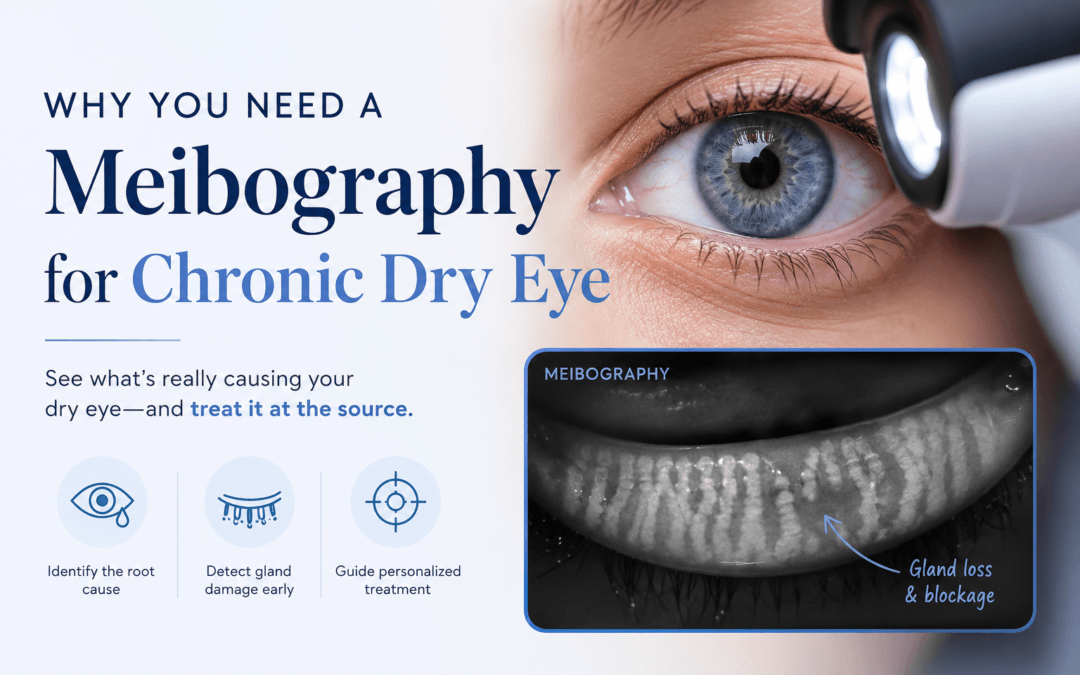
Meibography. The High-Tech Way to Solve Dry Eyes
We’ve all been there: you’ve been staring at a screen for hours, and your eyes start to feel gritty, burning, or like they’re filled with sand. Your immediate instinct might be to reach for some over-the-counter eye drops. But what if the real problem isn’t a lack of tears, but a lack of oil?
Enter meibography—the cutting-edge, painless imaging technology that is changing the way eye care professionals diagnose and treat dry eyes.
If you’ve been struggling with chronic eye discomfort, here is everything you need to know about this game-changing scan.
What Exactly is Meibography?
To understand meibography, you first need to meet your meibomian glands. You have about 25 to 40 of these tiny glands in your upper eyelids and 20 to 30 in your lower eyelids. Their primary job is to secrete a special oil called meibum.
Every time you blink, this oil coats the surface of your eye, creating a protective barrier that prevents your water-based tears from evaporating too quickly.
The Core Concept: Meibography is a non-invasive imaging technique that uses infrared light to take a “selfie” of these glands. It allows your eye doctor to see the actual structure of the glands, checking to see if they are healthy, blocked, or missing entirely.
Why Do You Need It? (The Dry Eye Connection)
When these glands get blocked or begin to wither away (a process called atrophy), it leads to a condition known as Meibomian Gland Dysfunction (MGD).
MGD is the leading cause of dry eye syndrome, accounting for up to 86% of all dry eye cases. Without that crucial layer of oil, your tears evaporate into thin air, leaving your eyes exposed, irritated, and red.
Before meibography, doctors could only press on the eyelids to see if oil came out. Now, they can look at the “infrastructure” of your eyelids. Meibography can catch gland loss before you even start experiencing severe symptoms, allowing for early, preventative treatment.
What Happens During a Meibography Scan?
If your doctor recommends a meibography, you can breathe a sigh of relief. The procedure is entirely painless, takes less than a minute, and doesn’t require any numbing drops.
Here is what you can expect:
-
The Setup: You will place your chin on a rest in front of a specialized camera, much like a standard eye exam.
-
The Flip: The doctor or technician will gently evert (flip) your eyelid upward or downward for just a few seconds to expose the inner surface.
-
The Photo: An infrared camera snaps a quick photo. Because it uses infrared light, there is no blinding, bright flash.
The resulting image looks like a black-and-white X-ray of your eyelid, where your glands look like a neat row of tiny white piano keys or vertical stripes.
Decoding the Results: What Your Doctor Looks For
Once the image pops up on the screen, your doctor will evaluate your glands based on a few key factors:
| Gland Characteristic | What Healthy Looks Like | What Dysfunction Looks Like |
| Length & Structure | Long, straight, and distinct lines. | Short, twisted, or distorted lines (tortuosity). |
| Population | Glands closely packed together with no gaps. | Large blank spaces where glands have disappeared (dropout). |
| Oil Quality | Clear, free-flowing oil (observed clinically alongside the scan). | Thick, cloudy, or toothpaste-like consistency. |
You Have Your Scan… Now What?
The best part about meibography is that it provides a visual baseline. If your scan shows that your glands are starting to shorten or drop out, your doctor can tailor a precise treatment plan to save the remaining glands. Treatments might include:
-
Warm Compresses & Lid Massages: To melt hardened oil and clear blockages.
-
In-Office Thermal Pulsation (e.g., LipiFlow or iLux): High-tech devices that apply targeted heat and gentle pressure to clear out clogged glands.
-
Intense Pulsed Light (IPL) Therapy: Reduces inflammation around the eyes to improve gland function.
-
Dietary Changes: Adding high-quality Omega-3 fatty acid supplements to improve the quality of your oil.
The Bottom Line
If you are constantly battling dry, tired, or blurry eyes, stop guessing which eye drop will fix it. Ask your optometrist or ophthalmologist for a meibography. Seeing your glands in living color (or infrared black-and-white) is the first step toward finding a long-term, effective solution for your dry eyes.
Recent Comments